


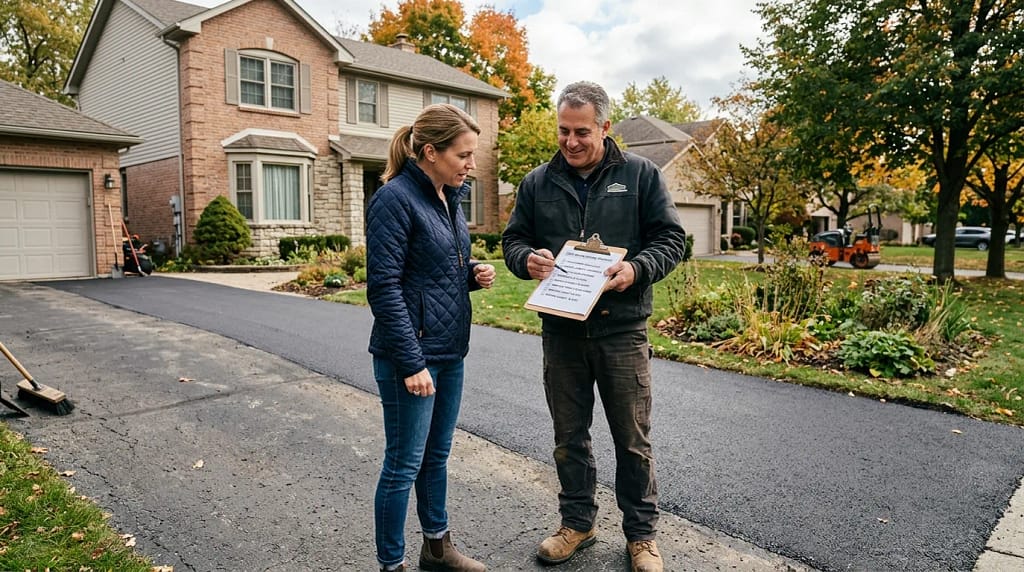
Don’t be part of the 90% of pavement failures. Use our comprehensive 25-point expert guide to hire a professional who builds to last.
Why Vetting Matters in 2026
Hiring a paving contractor for your residential driveway is a high-stakes investment. In 2026, the average cost of residential asphalt and concrete work has risen due to material costs and labor demands. Unfortunately, this has also seen an increase in “gypsy” paving crews and unscrupulous contractors who cut corners on the most critical part of your driveway: the foundation. Research shows that 90% of pavement failures are caused by poor subgrade preparation rather than the surface material itself.
At The Asphalt Advisor, we’ve seen homeowners lose an average of over $8,000 to paving scams. This checklist is designed to level the playing field, ensuring you get a driveway that lasts 20+ years, not two. Before you sign any contract, verify every point on this list.
Ready to start? Check out our 2026 Asphalt Driveway Cost Guide to set your budget baseline.
Phase 1: Initial Screening & Credentials
The first 5 points ensure you are dealing with a legitimate business entity that is legally permitted to operate in your area.
Confirm the contractor has a local, physical office or yard. In 2026, scammers often use “virtual offices” or residential P.O. boxes to avoid local service of process if things go wrong.
Request a Certificate of Insurance (COI) sent directly from their agent. Ensure it specifically covers “paving” or “street and road construction.” General landscaping insurance may not cover heavy machinery damage.
Paving is dangerous work. If a crew member is injured on your property and the contractor isn’t covered, you could be liable. Check your state’s online database to verify active status.
Verify that the contractor is registered with your city or county. Many jurisdictions require specific bonds to be posted for driveway aprons that touch public roads.
Ask for three references for jobs completed 12 to 18 months ago. You want to see how the pavement survived at least one full freeze-thaw cycle.

Phase 2: Technical Specifications
A professional contractor will not be offended by technical questions. If they can’t provide these specific numbers, they aren’t the right pro for your project.
The contractor must specify the depth of the aggregate base (typically 4-6 inches for residential). Crucially, ask if they compact to 95% Proctor density using a vibratory roller or plate compactor.
If you are choosing concrete, ensure the mix is specified at 3,000 to 4,000 PSI. Lower than this will lead to premature scaling and cracking. Learn more in our Comprehensive Concrete Driveway Guide.
Industry standards in 2026 allow 40–50% Recycled Asphalt Pavement (RAP). If the percentage is higher, ask if they are using chemical rejuvenators to prevent brittleness.
A contract saying “3 inches of asphalt” is vague. It must say “3 inches of compacted thickness.” 3 inches of loose asphalt becomes roughly 2.25 inches once rolled.
Your driveway must have a minimum 1% (preferably 2%) slope away from the home’s foundation. Ask how they intend to handle water runoff. For more on this, see our tips on preventing water damage.
Phase 3: The Contract & Project Scope
A handshake is not a contract. Protect your investment with detailed documentation.
Never pay 100% upfront. A standard 2026 schedule is 20-30% deposit, with the balance due upon completion and inspection.
For larger driveways or those on busy streets, how will they manage safety? Do they have cones, tape, and a plan for neighbor access?
The contract should state that the contractor will call 811 to mark underground utilities before any excavation begins. You do not want to be responsible for a severed gas line.
Will the edges be hand-tamped at a 45-degree angle? This “bevel” provides structural support to the edge of the asphalt and prevents crumbling.
If “soft spots” are found in your soil after excavation, the contract should specify how that is handled (usually an “extra” charge for geogrid or additional stone). This prevents the contractor from just paving over mud.
Phase 4: Execution & Equipment
What happens when the trucks arrive? These points cover the actual construction phase.
Does the contractor own their pavers and rollers, or do they rent them? Owners generally maintain their gear better, leading to more consistent results.
If you are getting an asphalt overlay, a “tack coat” (glue) is mandatory between the old and new layers. Ask what specific emulsion they use.
Where new asphalt meets old asphalt or a neighbor’s driveway, how is the joint handled? It should be a clean saw-cut and sealed with hot-poured rubberized asphalt.
Modern 2026 paving often uses rollers with sensors to ensure uniform density. Ask if they use technology to track compaction passes.
Who is responsible for removing the old chunks of asphalt? The contract should include haul-away fees. Note that in 2026, 99% of removed pavement is recyclable.
Phase 5: Warranty & Long-Term Care
The job isn’t done just because the roller stopped moving. You need protection for the years to come.
Expect a minimum of a 1-year warranty on both materials and workmanship. In 2026, top-tier contractors often offer 2 or 3-year limited warranties.
A reputable contractor will tell you to wait. New asphalt needs 6-12 months to “cure” before its first sealcoat. Anyone offering to sealcoat a week later is a red flag. Read our Essential Sealcoat Guide for more.
Does the contractor provide a guide on how to care for your new surface? (e.g., keeping power steering turns to a minimum in high heat).
Before making the final payment, request a “Lien Waiver.” This proves the contractor has paid their material suppliers, so the asphalt plant can’t put a lien on your home if the contractor goes bankrupt.
How are disagreements handled? Many modern contracts include a mandatory mediation or arbitration clause to avoid expensive court dates.
Frequently Asked Questions
The “traveling crew” scam is still prevalent. These crews use low-quality, “watered down” asphalt or simply thin layers that look good for a month but crumble by winter. They often use high-pressure sales tactics and demand cash upfront.
Yes, we highly recommend using our Asphalt Driveway Cost Calculator to get a baseline. If a contractor’s quote is 50% lower than the calculator suggests, they are likely cutting corners on materials or sub-base depth.
It depends on your climate and budget. Concrete is generally more durable but expensive, while asphalt is more flexible and easier to repair. Check out our Asphalt vs. Concrete Comparison for a side-by-side look.
Think of the sub-base as the skeleton of your driveway. If the soil or stone underneath isn’t compacted to 95% density, it will shift. When the ground moves, the rigid surface (asphalt or concrete) will crack to accommodate that movement. This is the #1 cause of asphalt cracking.
Save This Checklist Before You Hire
Armed with these 25 points, you are now more prepared than 99% of homeowners. For more expert advice on maintaining your investment, visit our Pavement Repair Guide.
Read the Ultimate Repair GuideNeed more help? Learn more about the Asphalt Advisor team or Contact Us with your technical questions.